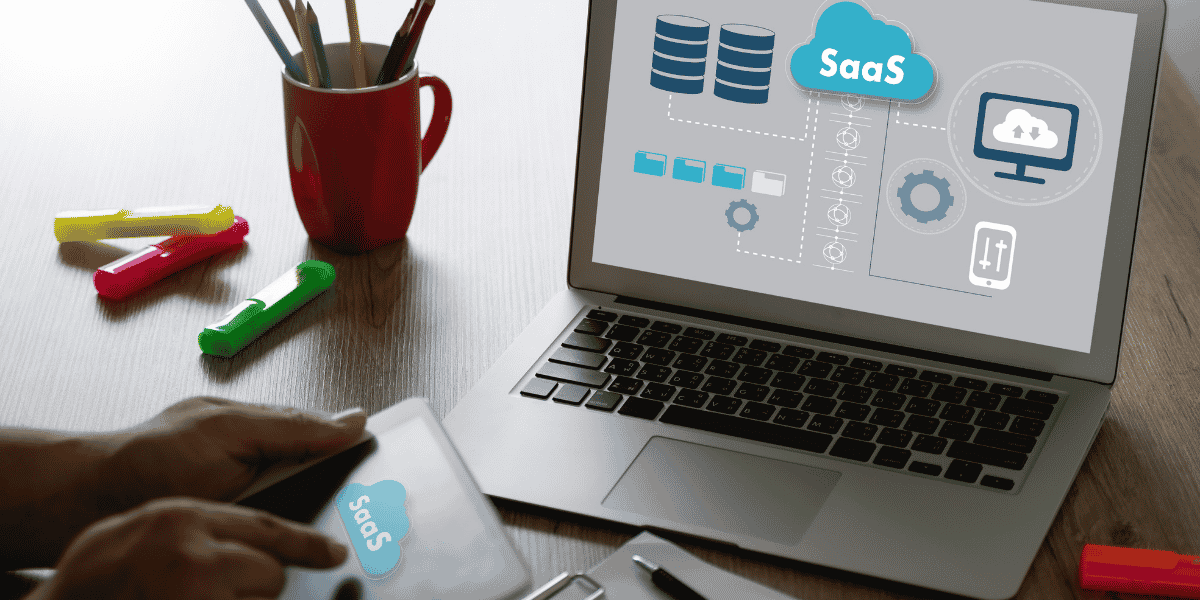
Picking the wrong technology stack for SaaS products costs founders months of rework, and the bill usually arrives right after launch. A technology stack is the set of languages, frameworks, databases, and cloud services that run your software. The right tech stack lets you ship fast now and keep scalability in reserve for later.
The money flowing into the cloud shows what is at stake. Gartner forecast worldwide public cloud spending of $723.4 billion in 2025, up from $595.7 billion in 2024. In this guide, you will learn what a SaaS stack includes, how to compare options, and how to choose with confidence.
What Is a Technology Stack for SaaS Products?
A technology stack for SaaS products is every tool your team uses to build, run, and secure a subscription software product. It works in layers. Customers see the frontend. Behind it, the backend handles business rules, the database stores records, and cloud infrastructure keeps everything online.
Think of a building. The frontend is the lobby, the backend is the wiring, and the cloud is the foundation. Weak wiring ruins a beautiful lobby.
SaaS adds demands that a normal website does not have. Many customers share one application, so your stack must keep each customer's data apart. Engineers call this multi-tenant architecture. You also need user roles, recurring payments, and near-constant uptime.
Why Your SaaS Technology Stack Matters in 2026
Your stack sets your speed, your costs, and your hiring options. A popular stack means more developers to hire and more answers online. A rare stack means slower hiring and higher salaries.
Security depends on early choices too. The IBM Cost of a Data Breach report puts the global average breach cost at about $4.4 million. Mature frameworks ship with protections that lower that risk from day one.
Developer habits also show where the market is heading. The Stack Overflow Developer Survey ranked PostgreSQL as the most-used database among professional developers in 2025. Widely used tools lower your hiring risk.
How a planned stack compares with the alternatives.
|
Factor |
Planned Stack |
Rushed Stack |
No-Code Platform |
|
Launch speed |
Moderate, then fast |
Fast at first, slow later |
Fastest |
|
Scalability |
High |
Often needs a rewrite |
Limited by the platform |
|
Long-term cost |
Predictable |
Rising rework costs |
Rising license fees |
|
Control |
Full |
Full but messy |
Low |
What Does a SaaS Technology Stack Include?
Frontend and Backend Layers
The frontend framework controls what customers click. React with TypeScript is a common pick because of its large talent pool. The backend framework runs your logic. Node.js, Django, Laravel, and Go all work well. Choose the language your team already knows. Familiar code ships faster than trendy code. Strong API integration support matters as well, because customers expect your product to connect with their other tools. An API-first development strategy makes that easier.
Database and Storage
Most SaaS products start with a relational database. PostgreSQL handles structured data, JSON, and tenant separation well. Add Redis for caching and object storage for files. Put a tenant ID on every table so one customer never sees another's data.
Cloud, DevOps and Security
AWS, Google Cloud, and Azure all host SaaS products reliably. Pair your host with a CI/CD pipeline so every code change is tested and deployed automatically. Add monitoring, backups, and subscription billing through a tool such as Stripe. Before launch, walk through a cloud application security checklist.
A quick reference for each layer of the stack.
|
Layer |
Popular Options |
Best For |
|
Frontend |
React, Vue, Svelte |
Fast, interactive dashboards |
|
Backend |
Node.js, Django, Laravel, Go |
Business logic and APIs |
|
Database |
PostgreSQL, MySQL, Redis |
Structured data and caching |
|
Cloud |
AWS, Google Cloud, Azure |
Hosting and scaling |
|
Billing |
Stripe, Paddle |
Subscriptions and invoices |
Technology Stack for SaaS Startups vs. Enterprises
For Startups
Startups need speed. Pick a mainstream, well-documented stack, lean on managed services, and keep one codebase. A single application on PostgreSQL with a managed cloud database covers most early products. Build only what your first customers need.
For Enterprises
Enterprises need control and compliance. Expect single sign-on, audit logs, data residency options, and detailed access roles. Their stack often adds Kubernetes and message queues. Reliability targets matter more than launch speed.
How to Choose the Right Technology Stack for SaaS Products
Start with your product's needs, not with trends. Run through these checks:
- Match your team's skills first, because familiar tools ship faster and break less.
- Confirm you can hire developers for the language in your region.
- Pick tools that scale out across servers, so growth does not force a rebuild.
- Add up total cost, including hosting, licenses, and maintenance time.
- Review security and compliance needs, such as GDPR or SOC 2, before you commit.
- Test the stack with a small prototype before you lock it in.
The erpo.in guide on how to choose the right tech stack walks through this process in more depth.
SaaS Architecture and Your Tech Stack: Monolith or Microservices?
Your SaaS architecture decides which tools make sense. A monolith keeps all code in one application. It is simple to build and deploy, so most early products should start there. Microservices split the product into small services. They let large teams work in parallel, but they add cost and complexity.
Compare both paths in this breakdown of microservices vs monolithic architecture. Many teams start with one well-organized application and split out a service only when a clear bottleneck appears.
Frequently Asked Questions About Technology Stack for SaaS Products
What is a technology stack for SaaS products?
A technology stack for SaaS products is the combination of frontend, backend, database, cloud, and security tools used to build and run a subscription software application. Each layer solves a different job. Together, they decide how fast you launch, how well you scale, and how much you pay to maintain the product.
How long does choosing your tools take?
Most teams need one to three weeks to choose a SaaS technology stack properly. That time covers requirement workshops, a short prototype, and a cost review. Rushing this step usually backfires, because changing core tools after launch can take months. A founder with a clear product scope can decide faster.
How much does a SaaS tech stack cost?
Most stack components are open source, so the real cost comes from people and hosting. Early cloud bills for a technology stack for SaaS products often run from a few hundred to a few thousand dollars a month, while developer time is the larger expense. See this breakdown of SaaS application development cost for full budgets.
How is SaaS architecture different from your tools?
A tech stack is the list of tools. Architecture is how those tools connect and share work. The same SaaS tech stack can support a single application or many services. Choose the stack for what your team can build, then design the architecture around your traffic and growth plans.
Do I need custom code if I use a no-code tool?
Not always. A no-code platform can test an idea quickly, and many founders start there. However, a custom technology stack for SaaS products gives you control over performance, data, and cost once paying users arrive. Teams often prove demand first, then rebuild through MVP software development services.
What is the best technology stack for SaaS products?
No single stack wins every time. A popular choice is React for the frontend, Node.js or Python for the backend, PostgreSQL for data, and AWS for hosting. This mix has wide community support, strong documentation, and plenty of available developers.
Which programming language is best for SaaS?
TypeScript, Python, and Go lead most modern SaaS builds. TypeScript suits full-stack teams, Python suits data-heavy products, and Go suits high-traffic services. The best language is the one your team knows well and can hire for easily.
Is PostgreSQL good for SaaS applications?
Yes. PostgreSQL handles relational data, JSON, and multi-tenant designs reliably. It also scales well with read replicas and managed hosting. Many SaaS companies pick it first because it rarely forces a painful migration later.
Can I switch tools after launch?
Yes, but it costs time and money. Swapping a frontend is usually easy, while changing a database or backend language can take months. Choose core tools carefully at the start, and keep your code modular so single parts can be replaced.
Choosing a technology stack for SaaS products is a business decision as much as a technical one. The right technology stack for SaaS products pays you back every time you ship a feature or onboard a customer. At erpo.in, our team helps founders turn stack decisions into working products. See how erpo.in's DevOps consulting services for startups keep releases fast and stable, and learn how cloud native development prepares your product for growth. Build on a foundation that fits your goals today and still holds when your customer base doubles.